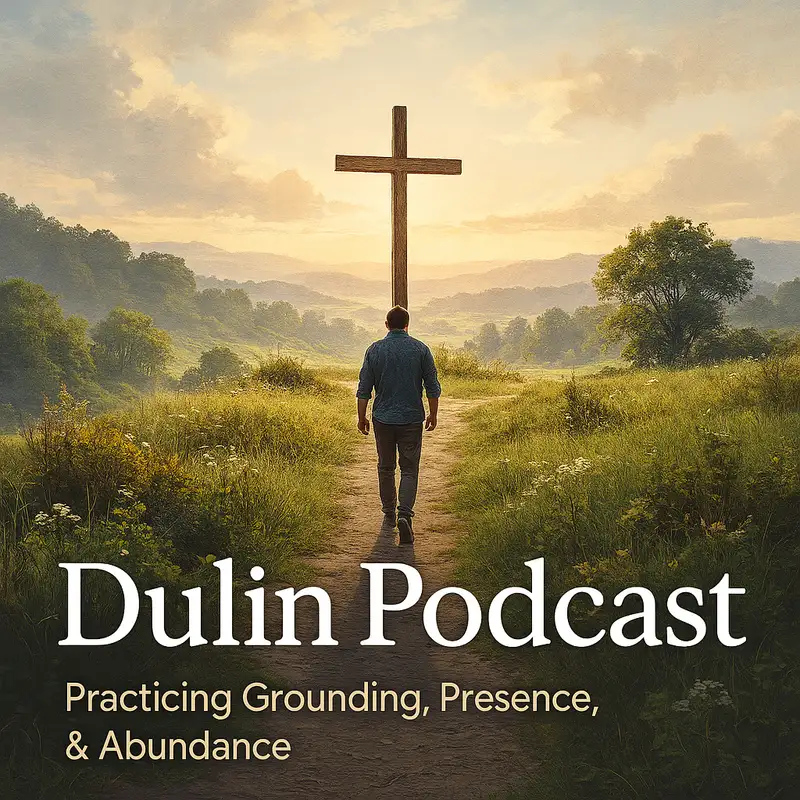
Welcome to the weekly Dulin Podcast, a ministry of Doolin United Methodist Church in Falls Church, Virginia. Each week, we share a short reflection on faith and life in community, exploring how God's grace moves among us and through us. We're glad you're here.
James:Hello, Dulin Church, and welcome to a weekly moment with your new pastor, pastor James. I am delighted to be with you today. And what I do in these weekly moments is take ten minutes or so to talk a little bit about something that seems to be pressing on my mind that might be helpful to you on your journey of faith. And speaking of journeys, that's what I want to talk about this week is about the practice of following Jesus. Now, you'll notice that I didn't say the practice of being Christian.
James:I talked about the practice of following Jesus. And the reason why I, talk about that is because I believe it is a practice. Being Christian is a state of being. That is, if you can imagine that in some way by being who you are, you are a follower of Christ. I think that's a great thing.
James:It's all about what you believe and where you find that belief. But when we talk about practicing following Jesus, what I'm talking about is the kinds of things we can do with our lives. The practices we can live into in our lives that will help us more closely follow in the path that Jesus set for us. I believe Jesus showed us a way to live, and the way he showed us to live was meant to help us live that way, help us be that way in our everyday lives. And so we look for him, and one of the best places, as far as I'm concerned, to look to that model is to read the Gospels, to read them closely.
James:Matthew, Mark, Luke and John all tell wonderful stories about Jesus. And in between the lines, as well as right out front, Jesus talks about how we can follow him. What does it look like to follow Jesus? Not simply to worship him, because I think there is, dare I say, a little bit of a danger in worshiping Jesus. And I'll tell you what I think the danger is.
James:The danger of worshiping Jesus is to elevate the man, the human aspect of Jesus, represented by the name Jesus, to such a level that we believe we could never follow in him. Jesus himself in the Gospel of John tells us we will do greater things than even he did. And the only way we could possibly do that, I think, is not simply to believe what he said, but to practice following what he did, who he was, because it sets us up for a life. So I'm going to choose three basic things that I see in Jesus' life. You could choose others.
James:You can choose more. You can choose less. It's up to you. But these are three observations I make about who Jesus is and how they help me guide my life. The first of those is that Jesus, we're told over and over and again in the gospels, often went off by himself, particularly at the beginning of the day to sort of ground himself.
James:We're told he went off into prayer. I don't believe that he just said a lot of words for several hours. I think while there is a place for that, Jesus himself cautioned in Matthew, in the Sermon on the Mount that we not say many words, that we practice saying lots of words like the hypocrites, but instead that we go into our, one translation says closet, I suspect what it really means is that we go inside ourselves, that we go inside in the silent places of our heart, that place where we actually contact with God in our everyday lives. And so Jesus went off, maybe he said words, and if that's what you want to believe, I encourage you to do just that, but I think that he was actually tuning his heart, tuning his heart to what God might have for him that day. Because if we tune our hearts, if we find our ground, our sense of peace, the place where we can live from, that is in sort of a resonant way connected to God that vibrates harmoniously with God's intent for our lives, then that's a great place to start our day.
James:We're already grounded. We're already open. We're spacious. We're aware of a larger field in which we're walking. It's not just about me.
James:It's about us and it's about participating in what God is doing in the world. We often refer to that as the kingdom of heaven or the kingdom of God. It's something we can participate in. It is something that is among us now and Jesus invites us to live into that. Now as a part of that kind of grounding in the morning, I think that it was a lot like what I'm making an allusion to Paul in Philippians chapter two where he tells us that Jesus emptied himself taking on the form of a servant or slave.
James:He emptied himself. The path of Jesus is about emptying ourselves of all of our own ambitions, of our own certainties about who we are and instead to let God shine through us, to ground ourselves in tune with that. Does that mean we're still ourselves? Absolutely. But it's not about the show I can put on.
James:It's not about my ego. It's about what God might want from me. So that would be the first thing that is grounding ourselves in a place of prayer. So I encourage you to find that place of grounding. I do every morning try to make that not just try, I make that space to ground myself.
James:And then because I get off base later in the day, I ground myself again later in the day because it's very important for me to stay grounded and in tune with God. Second piece. The second piece is being present. It grows right out naturally of grounding ourselves, of emptying ourselves, whether it be through centering prayer meditation. As we empty ourselves, we then prepare ourselves to be present with others because we're not so full of ourselves, of our own thoughts, of our own desires, of our own, you know, the things that we want to chase after, the things that distract us.
James:So when we're with another, we are fully present. Jesus did that. He did that, when he sat with the woman at the well in John chapter four. He did that when, when the woman who was, who had hemorrhage, who was bleeding and had been for some time, years and years touched his garment and found healing. Jesus was on his way somewhere else, and yet he stopped.
James:Who touched me? And he turned to the woman and was fully present with her. He practiced presence. People that nobody else seemed to care about Jesus stopped to talk to because for him, for Jesus, that being present was what really really mattered because when we're fully present with the other in a way they manifest to us and we manifest to him, to them, the other person, God's presence in our lives. Being fully present is what Jesus showed us, modeled for us, and practiced in his everyday life.
James:Last of all, when I think about who Jesus was, you know, fully grounded, fully present, he also lived from a place of abundance. And that place of abundance, we think of abundance as way overflowing, way more, more. That's, you know, kind of culturally what our world invites us to see. There's always got to be more. We've always got to seek after more.
James:But perhaps abundance is recognizing that who I am right now and what I have right this moment is enough for me. Now, are people in the world who don't have enough. And part of our work here at Dualin Church, we talk about it, part of our work is reaching out to those people and helping transform their lives through powerful ministries like Homestretch. Those are ways that we reach out into our community and help people find a new way of being. But we live our own abundance when instead of always looking for what's in it for me, what's next, how can I get more, when we take a step back long enough to say, right now I've got this heartbeat?
James:It's a gift. I've got this breath. It's a gift. I've got these thoughts, some of them that are just dancing all over the place, but even they are a gift. This moment I'm enough and I have enough to be present in this moment and it's a gift.
James:And enough is actually in abundance. We live from a place of abundance. Jesus modeled abundance over and over again. When he fed large groups of people, practiced abundance. When he healed people, he practiced the abundance of God.
James:God would love for us to find that kind of healing for ourselves, not through ourselves, through God's grace, through God's movement in our lives. But what's most interesting is oftentimes the word biblically that we think of as salvation also means healing, wholeness, completeness. God wants to make us whole. God wants to heal us so we can be fully engaged in the world because that's, you know, that's the beauty of the gift that God gives us of this life, this opportunity to be fully here. So grounding ourselves daily, regularly, keeping ourselves in tune with God.
James:Two, being present where you are, letting go of all the other distractions so that when you're with someone or several someones, you're really there. That's where you are. And third, living from a place of abundance, not always seeking how you can get more, accumulate more, how I can get more and accumulate more. But how can I live this life, this life energy, this gift God has given me as a from a place of abundance rather than trying to keep all things? I recognize that they're only passing through my hands to begin with anyway, including this life, this breath.
James:How can I give it away? Those are some thoughts for this week about practicing following Jesus. I wish for you all the best in giving it your shot yourself, following that path of Jesus. Always welcome your thoughts and pushback, your questions. Those are always wonderful ways you can reach out and share those with me.
James:Remember always, no matter where you are on whatever path you're on, you are infinitely precious and unconditionally loved for the gift you already are. Thanks for joining me today on this, the first of my weekly moments.