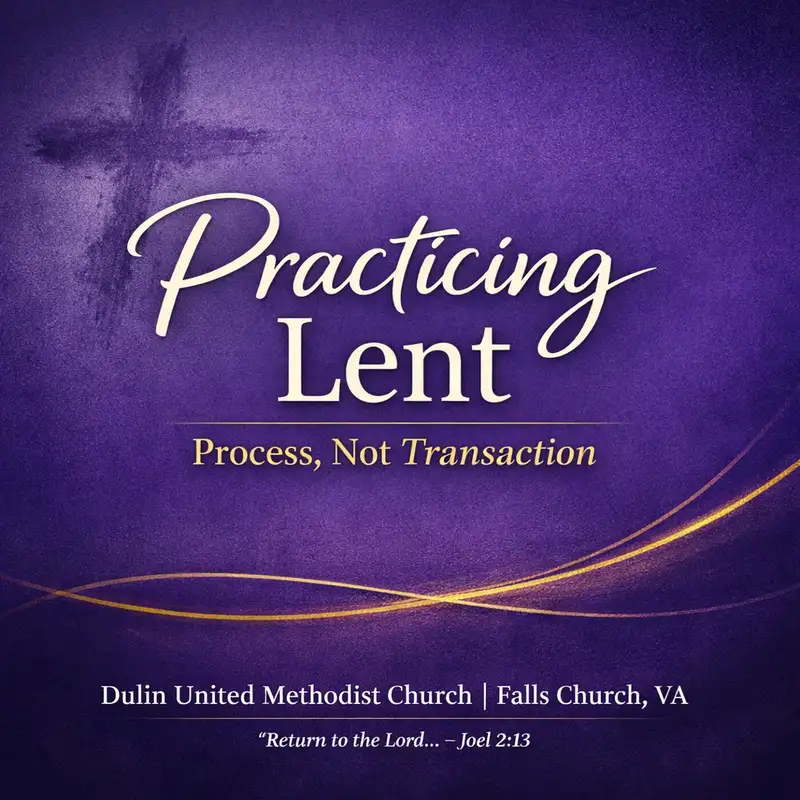
Welcome to the weekly Dulin Podcast, a ministry of Dulin United Methodist Church in Falls Church, Virginia. Each week, we share a short reflection on faith and life in community, exploring how God's grace moves among us and through us. We're glad you're here.
James:Hello, Dulin friends. It's me, James Henry, your pastor, and it's good to be with you for another Dulin Weekly Moment or Dulin Weekly Podcast, however you consume these times together. We have begun a very specific season in the church year. It is called Lent. It began with Ash Wednesday last night.
James:And Ash Wednesday, the reminder that we are indeed limited, finite, that we are mortal and that we have this one life to live. What will we do with it? Now, as we enter into the Lenten season, people may ask you the question, they may ask you, so what did you give up? What have you decided yet? Is it chocolate?
James:Is it coffee? Is it alcohol? Is it social media? The immediate assumption is that we'll give something up, sort of a subtractive meaning to practice as it comes into the season. And if that's your practice during the Lenten season, I want to say to you, I commend you.
James:It's nothing I have nothing negative to say about it. The only thing that I want to invite you to do if you're a practicer of subtraction in this season is to be mindful about that subtraction. Recognizing first of all, that you don't need to earn God's love by whatever you're subtracting out of your life. You're not proving anything to God by giving up on chocolate or coffee or social media. You don't need to prove anything to God and by the way, you're also not going to buy any more love from God because you can't have any more than the unconditional infinite love of God already.
James:It's already there for you. So, you're not earning anything. What you're opening yourself up to is noticing how what you may be doing anyway is noticing how much that giving up something, when you give it up and you reflexively want to go to it, perhaps you always pick up your phone whenever you find yourself bored, you pick up your phone and go to social media or you go to YouTube or you go to something that you want to watch or do, you're constantly playing a game or doing something. Perhaps when you give it up, all you're noticing is first of all, the reflex in you to depend on something, That you are dependent in that moment on social media or caffeine from your coffee or tea or that chocolate fix of the sugar that courses through your veins. Nothing about any of those things is necessarily bad.
James:But when you have come to place your dependence on those things, it's an invitation for you to say, wow, I did not realize how I have leaned into social media, chocolate, coffee, whatever it is in your life that you might have subtracted. It doesn't make you any better to give it up. It doesn't make you any worse not to. What it does is invites a reflection as part of a process during these forty days of Lent. You may choose some people I know during the Lenten season instead of subtracting something like fasting from that thing, they are additive in this season instead of subtractive.
James:So, they add a practice. Maybe it's daily prayer. Maybe it's scripturally reading like Lectio Divina, just reading a verse over and over several times, letting it become internalized, listening for what God says. Maybe it's being more regular in being generous to other people. Maybe it's I don't know, you might add any number of practices to your life.
James:And once again, I think that adding a practice, you know, first of all, during the forty days of Lent, it invites you to form a habit. And that habit, if it's a good practice, if it's one that helps you out, you form that habit. According to scientists, it takes what, about four weeks, twenty eight days to thirty days for you to form a habit. So in that forty days, you have time to form that new habit and it becomes maybe a part of your, you've tried it and now you see how important it is to your everyday life. For instance, you could add saying the Lord's prayer to your everyday, we've just talked about the Lord's prayer, we're not quite finished, we will this Sunday.
James:You could add praying the Lord's Prayer to your practice every day. Just once again remember that adding a practice or subtracting something is not proving something to God. This is not about showing God that you're good enough because God already loves you just the way you are. So you don't have anything to prove to God. What you have is the opportunity to practice something that may help shape or form your faith in new ways, open you to grace in places you didn't expect it to be.
James:It might help you realize that some of the things you're dependent on in your life, in the case of subtractive, some of the things you're dependent on are not as important as you imagined that they were and that perhaps you want to redirect your attention somewhere else. It's an opportunity to step back from those things. In the end, none of this is transactional. It's not a tit for tat. If I practice the little with God, then God will love me a little.
James:If I practice the lot with God, God will love me more. It's not a transaction. It's a process of being shaped, of asking yourself the important questions about what your faith really relies on, where you put your trust. Is it in those things that you might give up? You might discover that if you fast from something, give something up.
James:What are the things that you'd like to live into? You never imagined that praying the Lord's prayer every single day might reshape the way that you see the world and that you see yourself and that you connect with God. Then it becomes an important part of your life. It's about the process of being formed, of finding our relationship ever deepening with God. All of life, all of faith is a process, not just a tit for tat, this for that kind of relationship.
James:In fact, it's not that kind of a relationship. God is always going to love you first, and God's always going to give you grace first and hope, dream, and imagine that you will respond. But in the end, it's up to you to respond. This is a process of being formed bit by bit, step by step. Imagine for a moment the Grand Canyon did not happen overnight, took millions of years of erosion, wind and water that slowly bore it down to that beautiful situation.
James:Look at something like Luray Caverns are one of the places where you find beautiful stalactites and stalagmites there. It took tens of thousands of years of that constant drip bringing the minerals down to form the stalactites and the stalagmites in that cave. It's a process. It takes a while for a river to wear down the stones from being more jagged to being more smooth. And that we're entering a process.
James:These forty days could be that process for you. You saying to God aloud and to yourself, I commit to giving this up, to seeing if I'm really as dependent on it as I might be, or I'm taking this up, this thing up because in doing so, it might form me in different ways, transform me in new ways that I can't even foresee. I might learn a new habit that will help shape the rest of my life. In the end though, it's not about measuring yourself. So let's say you either take up a subtractive don't do that thing or an additive do this thing every day or however often you choose.
James:And what happens if you miss a day? If you this is not another opportunity. Lent is definitely not another opportunity for you to beat yourself up about the places that you don't quite measure up according to your own imagined set of standards. That's not how it works with God. You mess up, you forget today, you realize as you lay down in bed, whoops, I had prayed the Lord's prayer, planned it every morning and this morning I forgot.
James:There's tomorrow morning. They're saying it as you go to sleep in your bed. You might not get all the way through it. You might get through part of it and fall asleep in the midst of it. Don't beat yourself up.
James:Do it today. You realize you didn't do something yesterday? Do it now. With no recriminations, the opportunity to move forward is always opportunity to move forward. We learn as much from our mistakes, maybe even more as we do from our successes.
James:And it's not a competition. Somebody you know gets all of the days of Lent and they are, you know, golden with whatever their practice was. And you, you got twenty days of Lent. And the other days of lent you somehow missed. Did you try those other days?
James:Did you give it your best? Did you simply miss? Can you give yourself grace enough and know that God loves you anyway? It was your choice of practice or your choice to give something up. And in the end, what you fed on for those twenty days may be more than you ever imagined.
James:And it may encourage you to keep trying that thing, to continue to give up the thing that you thought you weren't that dependent on, but you found out you were, or to keep practicing that thing that even though you missed a number of days of practice was a practice that you found meaningful when you did do it. So keep trying, keep going out there, keep realizing this whole season is a season that can form you. It's a process of opening you to God's presence in your life. It's not another opportunity to open up a transactional relationship with God and realize when you fail, you know, that anything other than God already loves you and will fail or succeed and will keep doing that. So be mindful of that.
James:If you're giving up something, more power to you. If you've taken up something, more power to you. If you've done both, more power to you. If you've done neither, well, ask yourself the question, is there something? Is there something?
James:In the end, look for ways that God might be trying to form you in your life. That's what the Lenten season is about. It's a preparation for the Easter season. The Lenten season, forty days long, not including Sundays, and the Easter season, fifty days long, beginning on what we traditionally call Easter Sunday and ending on Pentecost, the fiftieth day. It's a preparation, as all of life is.
James:It's a practice, as all of life is. You can be intentional during these days. So remember your mortality, your finitude, your limitedness, and remember it by practicing the best that you can in whatever way you choose and know no matter what you are loved. Thanks for joining me today. If this has been helpful for you, I encourage you to share it with someone else And until the next time, I wish you all the very best.