Hi, friends, and welcome to the weekly Dulin Podcast, a brief weekly reflection from Dulin United Methodist Church in Falls Church. Here, we take time to think together about faith, community, and what it means to live as disciples of Jesus in today's world.
James:Hello, Dulin Church. It's me, James Henry, your pastor, and we're together now for another weekly moment. Or if you listen to it on the podcast, another weekly podcast, the Dulan weekly podcast. Either way that you consume this, we are delighted to have you. We hope that if this is meaningful to you, that you'll share it with friends, with family, with people that matter to you.
James:Obviously, if it's not so meaningful, maybe hang on and try again next week. We'll see what happens. This past Sunday, I talked about, it was week six of the Lord's Prayer series and I talked about forgiveness. Forgiveness is a very serious topic and we do talk a lot about it among the circle of people who follow the path of Jesus. Jesus seemed to think that forgiveness was very important, told a number of stories about it.
James:But I had some questions arise, particularly for people for whom the sound faded in the midst of my sermon and may have missed some of the further points I made. And so, I thought I would take an opportunity to say just a bit more about forgiveness because I think forgiveness is a core topic. And I did have some of you approach me about the possibility of offering my six week forgiveness seminar where we sit together and talk about the ways in which we can work toward being forgiven. So, that will be something to work out separately. Obviously, not the subject of today's work.
James:So, a couple of things. And someone brought this up, but it was a part of my sermon. And if you didn't hear it communicated, I want you to hear it communicated clearly. Clearly. Forgiveness is not saying that what was done to you is okay or wasn't wrong.
James:It's not saying that at all. At no point does it excuse whatever behavior hurts you necessarily. So, I am never saying forgiveness is never about just normalizing, making normative in our lives mistreatment at the hands of others. That is it's not okay. Somebody has hurt you, hurt your feelings, that kind of thing, or hurt someone you loved, or physically hurt you, or any number of ways in which people hurt one another.
James:This is not saying that what was done to you was all right, That was okay. What it is saying is you cannot hold on to that any longer because the person who is being damaged by the holding on of it is you, the one who is holding on. The person who did it may or may not even have known, sometimes it's intentional, sometimes it's unintentional, may not have even known that they hurt you. In which case, they don't even feel sorry about it because they don't know. Sometimes there's a place, even in forgiveness, in saying to someone, I don't know if you know this or not, but when you did this, I was hurt.
James:May not have been your attention, but I was hurt by that. I statements are always a good way of describing how you're feeling. I was hurt by what was done to me. But it is also recognizing that holding onto it, while it may seem that it gives you the illusion of control of the situation, that person did something to me and now I have them because I am holding on to that. We somehow sometimes think that we're in control then by being able to hold that against the person, but we're not in control of anything by doing the holding on.
James:It's an illusion. The letting go is a way not of saying that the person was okay in doing what they did, but that you're not going to let your life be shaped by it. Now, second piece of this that's very important, depending upon the kind of hurt that was perpetrated against you or that you experienced, Reconciliation with the other party may never be possible. It may never, not in this life anyway, be possible for you. And it's okay for that to be the reality.
James:Somebody who tells you that forgiveness means forgetting the past and just moving ahead as if nothing happened or reconciling with the person who wronged you, that may be their way of dealing with it. But I want to say that there's another way to see it. And my way, I'm not saying it's the right way, but it's a healthy way. There are relationships in which there is nothing healthy for you to further receive from that relationship. And it's okay to not try to reconcile that the relationship itself was damning to you, was damaging to your personhood.
James:It's okay not to try to renew that relationship, to invite that kind of behavior. That's up to you. Reconciliation in some instances is possible, but it is not always possible, So don't assume that it is, and I don't assume that it is. So forgiveness is a good thing. It is a core tenant.
James:Learning to let go of things, it is a core tenant of our faith that we share as people who follow the path of Jesus. It is never a statement that what was done was right. It is never a statement that what was done was right. It is a statement that I will not hold on to that thing which was done. I will not give it any more power than it already has to have hurt me by holding on to it as if I could control it or myself or the situation.
James:And last of all, it's okay if reconciliation doesn't come out of it. It's okay. Now, when we talk about forgiveness in relationship to God as opposed to with each other, then we need to know that God is a lot bigger than we are. I feel very fortunate that God's a lot bigger than we are. God is big enough to reconcile with us despite those mistakes.
James:But I also want you to understand something that when bad things happen to us they do leave scars and there are consequences that continue to follow us in life. They don't have to define who we are but they do show where we've been and perhaps teach us the lesson of where we were. Help us to better understand the life in which we live. Now, I was describing to it after worship on Sunday, was talking to Mary Mateer and hopefully it's all right that we were talking and that I've mentioned it out loud, but it was a public conversation where I shared more deeply from my own perspective, we were talking about forgiveness and she prompted me and our conversation led to me sharing a little bit about what I feel is true about forgiveness. You may or may not be familiar with a Japanese art form called kint sugi, and I may be mispronouncing it, and if I am, I'm very sorry.
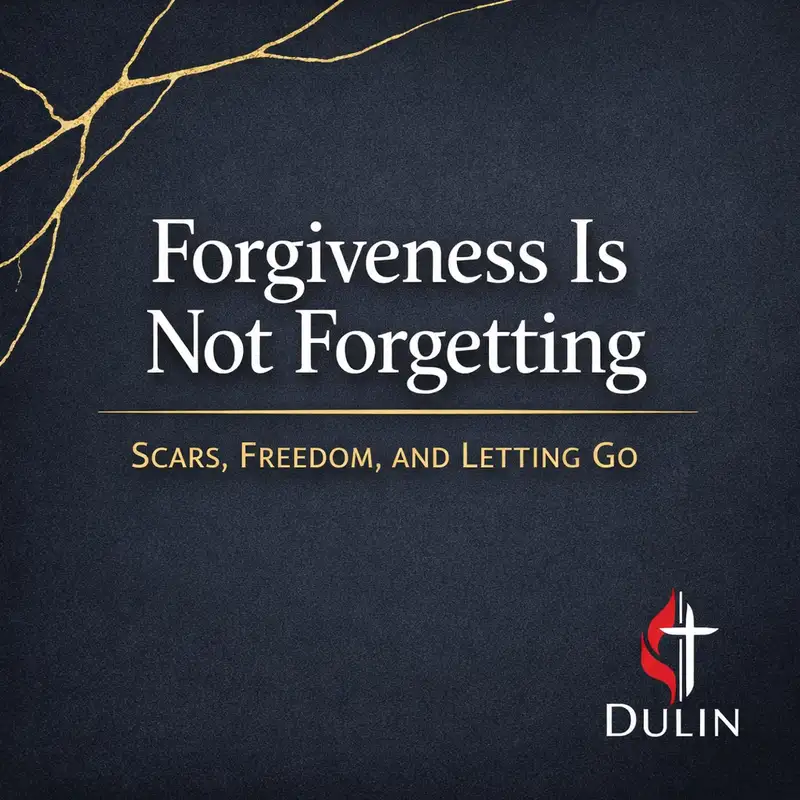
James:But kint sugi is taking broken pottery, if you have a pottery bowl or glass or cup and you break it, usually not on purpose, you know, just sometimes happens, rather than just throw away the pieces, you repair it. And in the Japanese art farm, Kintsugi, it's repaired with gold. Gold is used to rejoin the pieces. But then it becomes obvious from then on that this is a repaired piece of pottery. It's not the original piece.
James:It is changed by the experience of the repair so that it's very clear the veins of brokenness are clear in there. And if you wanna think of it in terms of Jesus, even after the resurrection, Jesus bore the scars. That's what he showed the disciples. Look at my hands, look at my feet, look at my side. There are the scars.
James:Even in the new life that comes from forgiveness, letting go of the things that were holding us in an old place and letting us move forward, even in the letting go, we will still bear the scars. The thing to be careful about is not to think that those scars define who we are because they don't define who we are. They show what we've learned, what we've discovered, and how we were changed. Forgiveness does not return us back to the original state. It doesn't return some kind of primordial innocence to us.
James:What it does do is allow us to move forward in relationship with this larger world, bearing the scars that we have learned from while at the same time engaging the larger world. I hope that that offers some kind of clarity for folks that were concerned about some of the things I said. I think I said all those things with the possible exception of Kintsugi, the art of Kintsugi, which came up in my conversation with Mary. I think I mentioned those, but I wanted to be clear because forgiveness is so important, I don't want us to mistake what forgiveness is or isn't. And as always, I invite you to respond to me, Dulin Church, or anyone who watches this.
James:Pastordulinchurch.org, D U L I N, dulinchurch.org, all one word. Feel free to email me your response, your thoughts about what forgiveness is, the images that come up for you. Maybe Kintsugi isn't what it is. Maybe something else is what it is. But the sense of what does repair in a broken universe look like?
James:What does repair in a broken relationship look like? Something worth pondering, thinking about, especially for something so important and so core to who we are. How is God affected by forgiveness? Forgiving us and the impact we have on that relationship, that trust that we've broken. It's worth considering.
James:It's worth thinking about. So, I encourage you to do that. Thanks so much for joining me. If this has been a helpful conversation, I encourage you to share the podcast, the moment with somebody else. If you have responses, thoughts, stories to share, I am delighted to see those kinds of things in my email box as opposed to thousands of advertisement for things I'll never need.
James:I love to see the things that pop into my inbox that are your own personal reflection. So please feel free to do so. But until the next time we see one another, I wish you all the best on this journey of faith and on this trying to figure out what forgiveness looks like for you.