Welcome to the weekly Dulin Podcast, a ministry of Dulin United Methodist Church in Falls Church, Virginia. Each week, we share a short reflection on faith and life in community, exploring how God's grace moves among us and through us. We're glad you're here.
James:Hello, Dulin Church. It's me, James Henry, your pastor, and it's good to be with you today for our weekly moment and our weekly podcast. You will remember, or maybe this is your first time with us. And if it is, welcome. We're delighted to have you with us.
James:If this is helpful, share it. And we encourage you to do just that. We try to in the Doolin weekly podcast and weekly moment to talk about something that comes from our roots in the church that speaks to us. And so for the last two weeks, and this week and the next, we are talking about the Wesleyan Quadrilateral. If you don't know what that is, that's okay.
James:I'm going to give an overview. First of all, John Wesley never explicitly described the quadrilateral. It was described about him much later by Albert Outler, one of the Wesleyan scholars in the twentieth century who saw that John Wesley was interested or spoke of faith as having its origins, some ways of understanding what faith was all about in four different ways: scripture, tradition, reason, and experience. The first week I talked about experience. The second week I talked about reason.
James:Going in reverse order, you can see. So, this week we're talking about tradition. Now, tradition might be the thorniest of them and the only reason I say that is because for some people the idea of tradition feels confining. It can also feel controlling as if the way that we've done things, particularly there was a period in the church when we excluded women from leadership. There was a period in the church when we excluded people based on their sexual orientation in a variety of ways, especially from leadership.
James:There are other ways in which we have been exclusive. We certainly had a terrible time when we became exclusive based on race. And there was a time in our history and that is part of our tradition. The traditions that have come to us, the things from our past that we have discarded because one of the things that happens with tradition is we don't say, we've always done it that way and this is the right way. What we do is we try to take the learnings of those who have come before us and see how they can teach us about things like prayer and communion and the way we worship and the songs we sing and the way we act in the rest of the world.
James:Perhaps there are some ways in which tradition can inform us. John Wesley was very fond of tradition. Now of course, John Wesley we think of as the founder of the Methodist movement and he was, but before him, he relied on a lot of tradition. He was very fond of the early church writings. He was very fond of the creeds because he felt like they were ways to push against our belief and encourage us, give us kind of some guidelines, some rails in which to work.
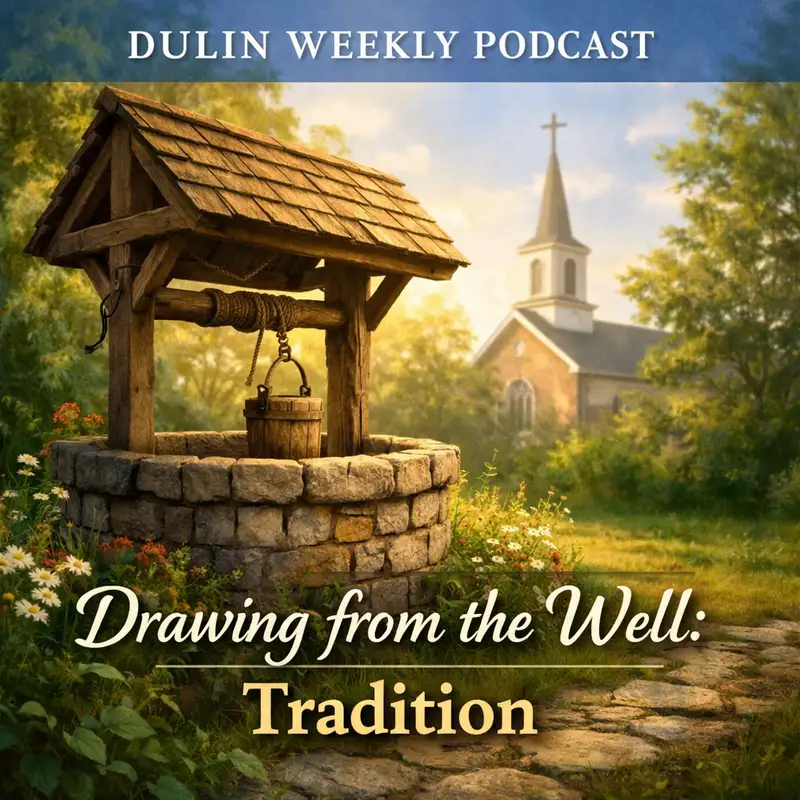
James:He saw tradition as a gift and then he passed on some new traditions. I want you and I today to imagine that tradition is like a well. It's something that, you know, that a part that can become a part of our lives and that space from which we can draw some guidance, some sustenance sometimes for our lives even now. A way of thinking about tradition, for instance, As we've and we haven't talked much about scripture yet, that's our next week conversation, but what do we do in terms of interpreting scripture? How do we find in scripture what is meaningful to us?
James:How do we find things like this doctrine that's called the doctrine of the Trinity, that God is one person in three and three in one, father, son in spirit, creator, redeemer, sustainer, that triune God who is in constant dance with one another, That's not particular, it's not unbiblical, but it's not written in the Bible. Nowhere is it described as we needed to believe in a triune God. The triune God was a way that later folks in the hundreds and thousands of years afterwards came to articulate an understanding of God. Jesus was constantly talking to his father in heaven, and he talked about leaving the spirit with us. So though he may not have articulated all three, we see three in that piece.
James:And so later folks in our tradition articulated it in that way. So many things about how we do worship, how we pray, folks are passing that down to us like a baton in a relay race. And we go to that well and we draw from it what may nourish us. Now, we also know that wells can be poisoned, wells can run dry, wells can stop to feed us as we are right now, or for some reason the depth of the well makes it too deep for us to draw anything that is meaningful to us or speaks to us right now. John Wesley would always want us and I don't want us to lift him to some kind of godlike stance.
James:He is merely the founder of our movement, the Methodist movement. But he had some ideas that we carry forward in tradition that have been helpful, at least to me and my faith. His desire for us to practice our faith, for instance. That's a very Methodist tradition. Practicing faith is more than just sitting quietly in a chair and praying.
James:For John Wesley, practicing our faith meant going into the world and impacting the lives of those who needed children who need to be educated, who did not have access to education in John Wesley's time. He went out into the world and for those who were hungry and poor, he sought to find ways to mitigate that. For those, you know, we've talked about schools, Methodists are also known at least for a period of time for founding hospitals because he believed that people should have access to healthcare. These are all traditions that carry forward to today. Some of our institutions of higher learning.
James:Did you know that American University in Washington, DC is a Methodist school? Duke University, is the United Methodist school. Emory University in Atlanta is the United Methodist school. In the Commonwealth Of Virginia, we have Shenandoah University, Farram College, Randolph Macon University, Virginia Wesleyan College, all of those, maybe it's university now, Virginia Wesleyan University. These are all, Methodist schools founded by strong Methodist folk because they felt like we needed access to education.
James:And so they did just that. So, tradition is not always bad. It helps form, it becomes a conversation, a place to have conversation. Does the Trinity still bear meaning for us today? I would say yes, but there are people that question.
James:A twentieth century theologian whose name was Karl Rahner, Catholic theologian said, you know, for many people we could stop speaking of God as Trinity tomorrow and it would make no difference at all to their faiths. Now you may say, wait, wait, wait, we've got to keep the Trinity, or maybe you don't say that, but where does it impact our everyday lives? How does it help us articulate what our faith is? Are there ways we can speak of Trinity that help us connect with life? You know, we've come to develop ways of speaking about how God reconciles with us, how God forgives us.
James:And one of the traditions that we carry on here at Doolin Church and many churches across the country is the prayer Jesus taught us to pray on a regular basis. He said when we pray, we should pray the Lord's prayer. That is a tradition. It's from scripture, but using it as a part of worship on a weekly basis, as a part of our personal prayer life, that's a tradition that's come to us. The shape of our building, the use of an organ in the building.
James:Would you believe that at one point playing the organ when organs were first introduced into worship, it was considered blasphemy by many people. They were used to encapella singing And they thought bringing an instrument into the church was a heresy, was blasphemy against God. So, you know, some traditions change. That, you know, the prior tradition of acapella singing changed to organ music, changed to piano music. Many modern day churches use things like bands with guitars and drums and a group of singers, violins, all of those pieces are represent a changing tradition that over time we adapt to speak the good news to the time we're in, but we learn from our ancestors.
James:We wouldn't be here today were there not ancestors in the faith that handed us the faith. Even if there are aspects of that same faith they handed us that we have rejected, they still were the ones who handed it on. When we speak about the saints who have gone before us, we're talking about those who gave us a legacy of faith, who passed it on. We have to make faith our own. We have to figure out how it speaks to us.
James:But tradition can be one of the aspects that informs the way we see it. So tradition doesn't have to be a bad word. The well from which we draw that which comes from before us can be honored, but there are aspects that our forebearers in faith didn't get right. And we have the opportunity as well to reject some of those pieces and to be very careful how we adopt them as we build traditions that we hope to pass on to future generations of those who follow the path of Jesus. So, scripture, tradition, what we talked about today, reason and experience all inform or can inform the way we live and see our faith.
James:I encourage you to ponder ways that tradition comes into play in the way that you do things. Where we put a chrism on tree in the sanctuary at Dulen, what kind of music we play, where is it shaped, who wrote those kinds of things. The fact that one of the traditions we have on Sunday mornings, if you come in person to Duolin, is coffee talk. Right after worship, people stay after and share some coffee. All those pieces are part of our tradition.
James:Some we keep, some we move on from, but we learn from them nonetheless. So look for the traditions in your life. What are the good ones? The ones that help inform your faith and what are the ones that maybe leave you hanging? No matter what you do with those traditions, always interested in hearing what you think of as tradition.
James:Used to think of big tea traditions as the ones that really mattered that needed to be passed on and little tea traditions like where did the Chrismont tree go or whether or not we light two candles or four candles or no candles on Sunday in worship. Those are little t traditions that we can keep or not depending upon their meaning for us. So always interested in hearing about your traditions, about the traditions you see as important to faith or not, you can always write me at pastordulanchurch dot org. But until the next time I see you, I wish you all the best and I hope you'll have a good and delightful day.