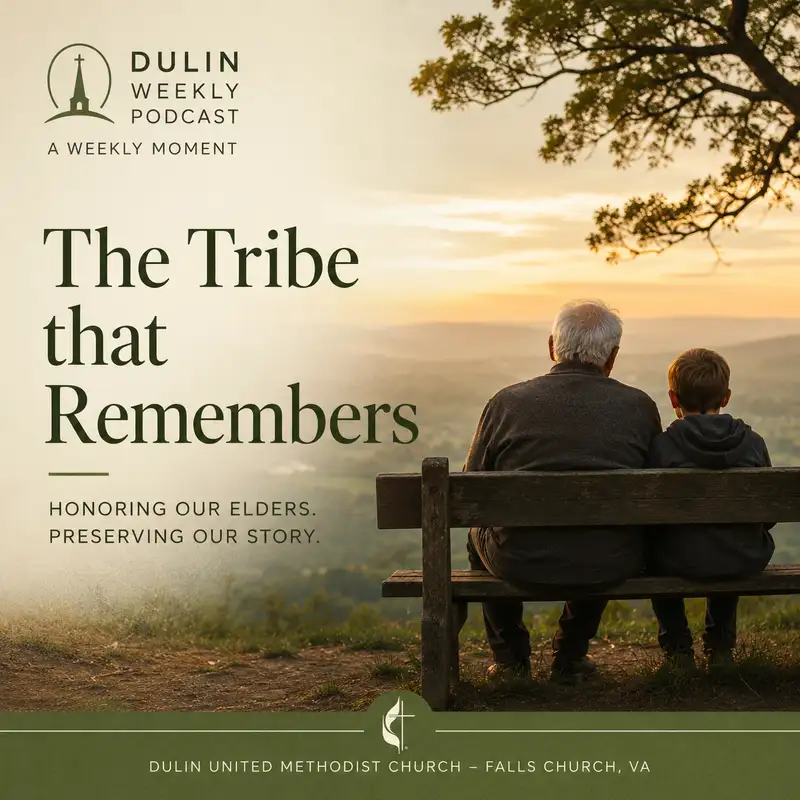
Hi, friends, and welcome to the Weekly Dulin Podcast, a brief weekly reflection from Dulin United Methodist Church in Falls Church. Here, we take time to think together about faith, community, and what it means to live as disciples of Jesus in today's world.
James:Hello, Dulin Church. It's me, James Henry, your pastor. I'm delighted to be with you. It's time for another Dulin Weekly Moment, Dulin Weekly Podcast. And I'm so glad you could join me.
James:Hopefully what we'll talk about might inspire, cause you to think, or encourage you in your faith journey, maybe all three. So I've been thinking a lot about our elders. Not so much because I'm becoming one, although I am. It's been because over the last couple of years I watched as my father tried to tell me what he hoped I would do after he had passed for my mom. And how the rest of us, my brother and sister, would do the same.
James:And then when he died last year, trying to honor that wish, trying to honor my mom and my parents. And today, what rose in my reflection is one of the 10 commandments, honor your father and mother that your days may be long in the land. And I've been thinking about it because it matters how we interpret that, how we hear that text. When I was growing up, it was sort of translated for us in our Sunday school classes and perhaps parents across the world have translated it as obey your parents. I'm not telling you you can't choose to use that, but that is not the deepest meaning of what honoring your parents is about.
James:Those 10 commandments were written at a time when for many cultures, particularly nomadic cultures, once a person was no longer productive in a place where there were limited resources and limited possibilities, they could be it was often the custom of various tribal cultures to let them die, to let them go because they were no longer of value, particularly productive value to the tribe. Sound a little bit like today? We think people are, as long as they're productive, they're great and maybe not so much so, maybe culture hasn't changed all that much in three, four thousand years. But this particular commandment is the it's about giving weight to something. It's not about obeying someone, particularly when you're a small child, although obedience to your parents is a good thing.
James:I want to affirm that. Honoring your parents is recognizing that there are no disposable people and your parents, the ones that give you life, are worth honoring for as long as they live. There are no disposable people. Over and over again, if you read particularly the Hebrew Bible, what some people call the Old Testament all the way through, you hear that there is a special place for widows and orphans and foreigners in the land and for those who are on the margins who can't quite fend for themselves. Those people are important.
James:This commandment is really about taking that seriously. Honor the elders as ones who produced but no longer can, but perhaps what they provide for you is more than something that you can measure by productivity standards. They provide you with cultural memory. They provide you with stories about how the tribe became who it is. They provide you with a sense of identity, who you are and why you are who you are.
James:And they have a kind of wisdom. They're not quite so reactive as oftentimes younger folks tend to be. I'm not saying that's across the board. We all know reactive older folks, reactive younger folks. We know wise younger folks who are a little bit slower and more intentional in the way they behave just like we know older folks that do the same.
James:But in generalities, this commandment is an invitation, a command. It's not an invitation. A command that we honor those for their eldership, for their wisdom, for what they have brought to the tribe in the past but what they bring now. And that honoring matters because a tribe and here's another way to hear this passage, the tribe that honors their elders is one that will endure. You know, the text can literally be translated.
James:And you know, I've read it many times and I have probably preached on it the way that it is literally translated. Honor your father and mother that your days may be long in the land. But what if part of the promise is in that underlying that peace is more than just you'll live a long life if you're good to your parents. It is those who honor those elders, those who have been on the journey for longer, those who are the older generations, the giver of life, those who honor them will endure because the memory of their culture will endure because they will not treat people as disposable. And they won't measure people so much by productivity as all of us being a part, an important part, a participant in the life of the tribe.
James:And for us, that tribe is humanity. We all bring something to the table. Give weight to those who have walked a longer path than you because they've seen more, perhaps experienced more, perhaps experienced it differently, perhaps see the world with a perspective that is bigger than might be considered to be the case in small individual cases, but in a much larger way see themselves as the people whom God might use to help us on that path, that journey that is before us all. So when you think about the significance of this commandment, Honor Your Mother and Father, That Your Days May Be Long in the Land, Think of it as a reminder as well as a commandment to honor those who are our elders, to treat them with respect and with dignity, to treat all those who might otherwise not be the productive members of society any longer, might not produce in the way that we measure as a culture, but who have produced and who now produce memory and wisdom and experience and shared story and identity that we can all gather ourselves around. So think about those in your life who are your elders, who are those for whom it matters that you care for them?
James:Who are those in your life who you might honor in ways that perhaps you haven't been all along but there's an opportunity for you to reevaluate the way you see those who have laid the groundwork for us, who have gone before, who are ahead of us in the great caravan of life, who have beaten down the path that we might follow along. What would it look like to honor some of them? Might be a call, it might be a note, it might simply be deference when an elder in your life speaks. You may not agree at all times quite frankly, I understand that completely, but you can certainly honor their voice because they bring a memory and an intention that is worth hearing. Honor your father and mother that your days may be long in the land.
James:Trust the elders. Listen to the elders for in so doing will you bring endurance to the culture itself. Just a thought for this week. I hope that you have a good week. I hope that this has been helpful to you in a thought.
James:It's one that I've been positing and pondering today. So I wish you all the best. Until the next time, have a great week.